

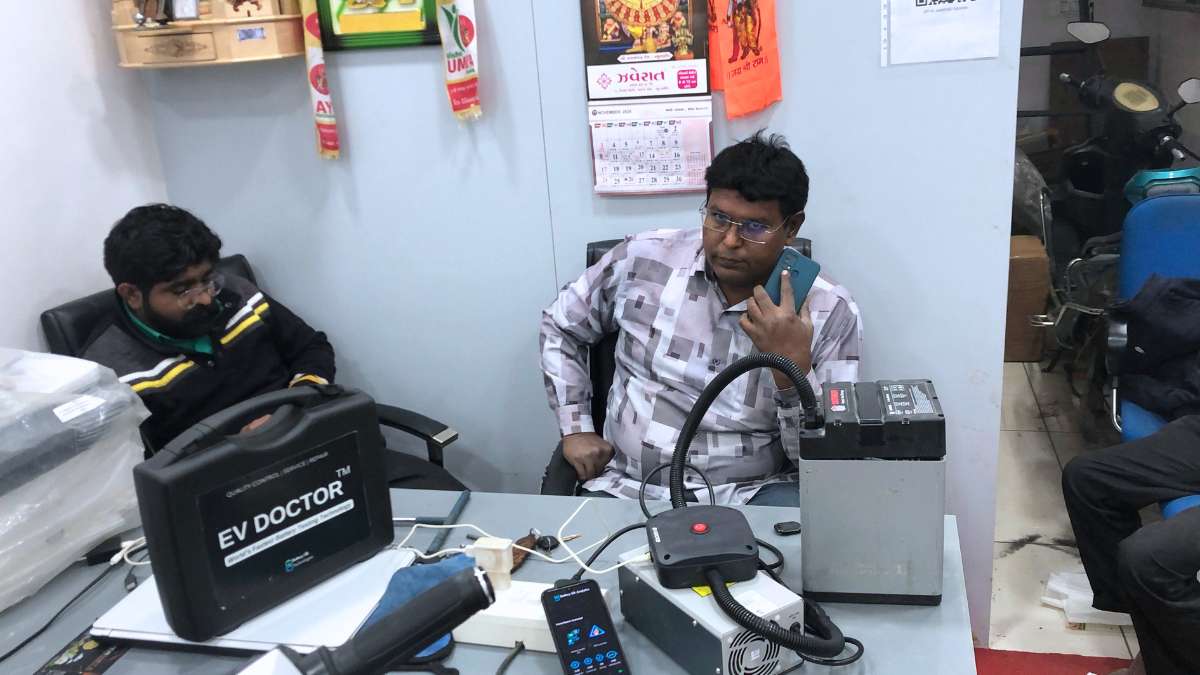
The same garages that once repaired Splendors, Activas and Pulsars are now learning to service electric scooters. Some of them are making good fortunes out of it.
The numbers tell you why. India sold 1,149,334 electric two-wheelers in FY 2024-25, a 21% jump over the 948,561 units sold the previous year. Across calendar 2024, electric scooters and motorcycles made up 59% of all EVs sold in India, up from 56% in 2023. Annual e-2W sales are projected to rise from around 1 million in 2023 to 7–9 million by 2030. India is now the world’s second-largest electric two-wheeler market after China.
The mechanical tools and spanners are still there. The air compressor is still there. But next to them, new tools have started appearing: multimeters, battery balancers, insulated gloves, chargers and battery diagnostic devices such as EV DOCTOR.
For many mechanics, the job is no longer only about engine sound, clutch feel or carburettor tuning. It is now about reading voltage, current, battery health, safety signals and ground fault patterns.
The reason is simple.
Thousands of EV scooters sold between 2021 and 2023 are now coming out of warranty. Customers are walking into local garages with familiar complaints: “Range kam ho gayi hai”, “charging issue aa raha hai”, “battery cut ho jaati hai”, or “scooter suddenly bandh ho gaya.”
These are not isolated complaints. By late 2024, electric scooter makers were under regulatory lens over more than 12,000 after-sales service complaints, with the Central Consumer Protection Authority and ARAI investigating warranty and service deficiencies. Common issues reported by owners across brands include rapid battery drain, motor controller glitches, and hardware faults, with many customers turning to social media as their only recourse after repeated visits to authorised service centres failed to resolve their problems. And the mechanic is being asked one important question:
Can this battery be repaired, or does it need replacement?
That is where the workshop business is changing.
The OEM service network simply has not kept pace with sales. India will require between 100,000 and 200,000 skilled EV professionals by 2030, while current training output is unlikely to exceed 15,000–20,000 trained EV technicians annually. Service availability is concentrated in metropolitan areas, leaving semi-urban and rural markets underserved. For a customer in a tier-2 town whose scooter has crossed warranty, the nearest authorised service centre may be 40 km away, with a two-week wait for spare parts. The neighbourhood garage, on the other hand, is 500 metres down the road.
A proper EV battery checkup can help a garage understand whether the issue is cell imbalance, deep discharge, connector damage, BMS fault, moisture impact or general battery ageing. Tools like balancers, multimeters, CDC machines and EV DOCTOR devices now form part of the new EV service bench.
Devices such as EV DOCTOR are becoming useful in this process because they help workshops test battery health, safety, performance and faults in a structured way before and after repair. Instead of relying only on guesswork, the mechanic can explain the issue with more confidence. Mechanics charge Rs 300–500 for a battery checkup alone, and the additional repair cost as per the report generates more revenue for them, while solving battery issues for consumers.
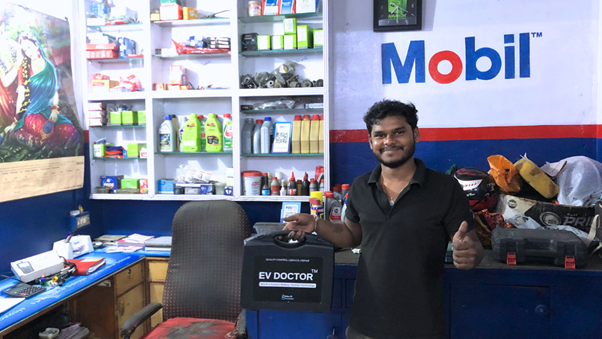
After the battery diagnostics, tools like CDC and balancers help during deep discharge and imbalancing issues.
Once repaired, the batteries are checked again for confirmation.
These three or four tools are quietly making garages EV ready.
The opportunity behind this shift is significant. With over 1.1 million new electric two-wheelers entering the road every year, and the fleet on the ground now well past 3.5 million units, the volume of out-of-warranty batteries arriving at workshops over the next 24 months will be unlike anything India’s two-wheeler aftermarket has seen before. Battery replacement on a single scooter costs Rs 25,000 – 45,000 atleast. A diagnosed and repaired battery, in contrast, may cost the customer Rs 1,000 – 6,000, while still leaving a healthy margin for the workshop.
For the customer, it builds trust. Because now it is not only about replacing the battery, they can be repaired too.
For the garage, it creates a new revenue line.
A basic battery diagnosis may be a small service, but the repair opportunity behind it can be much larger, from balancing cells to cleaning connectors, resetting BMS, correcting wiring or servicing the pack. More importantly, it makes the workshop look more professional.
This shift does not mean petrol mechanics are becoming irrelevant.
It means they are upgrading.
India’s EV revolution will not be carried only by showrooms, OEMs and large service centres. It will also depend on thousands of local mechanics who understand their customers, their vehicles and their daily usage better than anyone else.
The future EV garage may still look familiar from outside.
But inside, the workbench is changing.
And India’s EV story may quietly be written there, one battery, one mechanic and one diagnostic report at a time.
